

- The Mechanics of the Doubling Formula
- Real-World Timelines: From Savings to Credit Cards
- Testing the Math Against 2026 Market Realities
- The Golden Reverse Application
- Number Face-Off: 72 vs. 70 vs. 69.3
- Compounding on a Massive Scale: The Berkshire Reality
- The Dark Side of Compounding: Systemic Risk
- Frequently Asked Questions (FAQ)
- Conclusion rule of 72 investing
Updated: March 2026
The most powerful concept in personal finance does not require a complex spreadsheet or an advanced degree. It fits on the back of a napkin. If you want to know how fast your money will grow, you just need to understand the rule of 72 investing framework.
This simple mental shortcut tells you exactly how many years it takes to double your investment. You simply divide the number 72 by your expected annual rate of return. That is it.
In this guide, we bypass the academic jargon. We will look at how this math holds up against extreme 2024 and 2025 market data. We will also explore the systemic risks of compounding, Warren Buffett’s incredible track record, and exactly where this famous formula breaks down.
The Mechanics of the Doubling Formula
At its core, the math relies entirely on the magic of compound interest. Compounding happens when your investment earns a return, and then those returns start earning their own returns. It creates an exponential snowball effect.
Using the formula is incredibly straightforward. You take the number 72 and divide it by the percentage of your annual return.
For example, if you buy a mutual fund that grows at 8% per year, you divide 72 by 8. The result is 9. This means your initial capital will completely double in exactly nine years.
You do not need a calculator to figure out your financial trajectory. The rule of 72 investing principle gives you a clear timeline in seconds.
Real-World Timelines: From Savings to Credit Cards
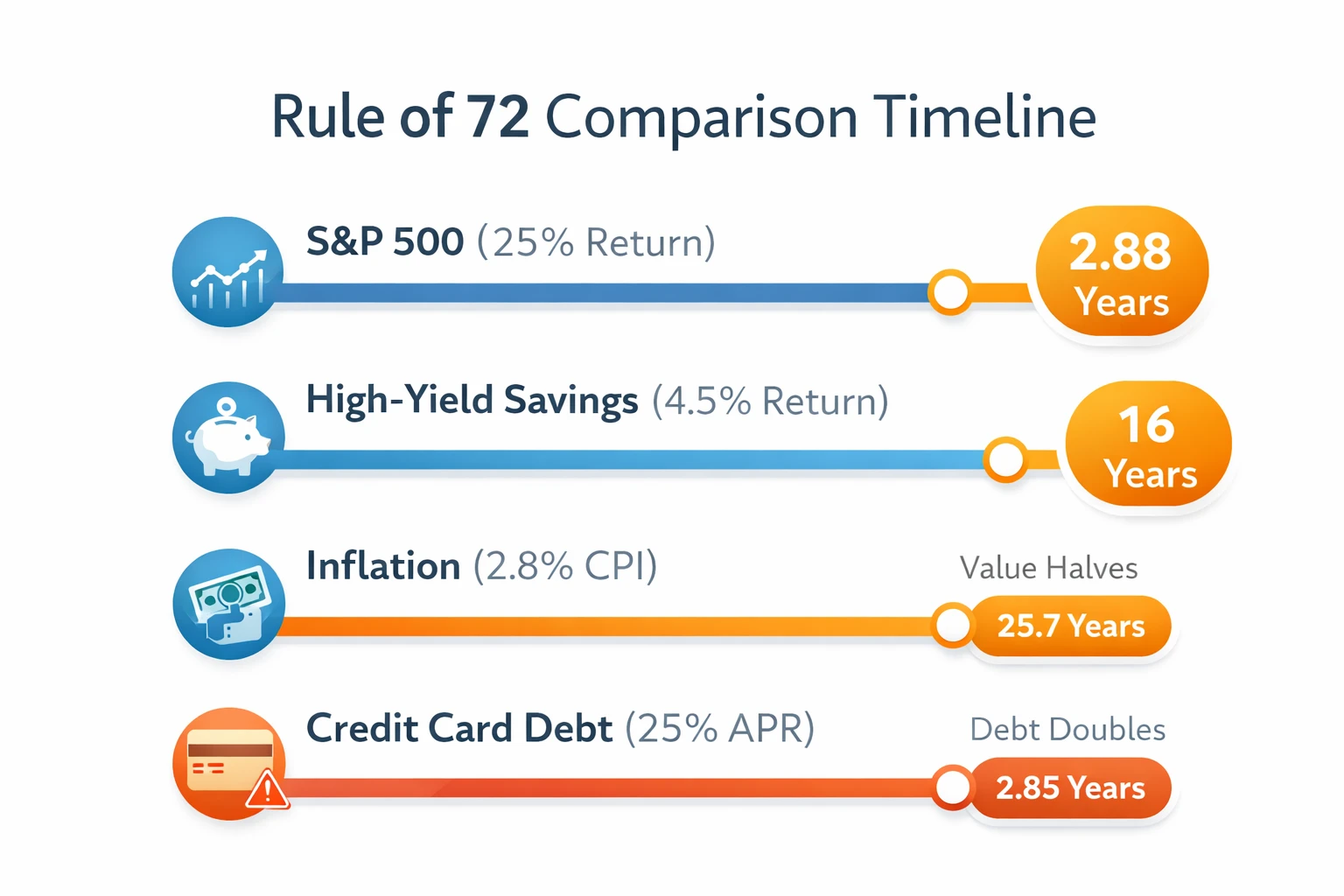
Seeing this math applied to everyday financial scenarios makes its true power obvious. The difference between a basic savings rate and a stock market return is not just a few dollars.
It is the difference between doubling your wealth in a few years versus a few decades.
Here is a look at how different financial vehicles performed recently, using real market data to calculate the doubling time.
- S&P 500 in 2024 (25% return): 2.88 years. A remarkably strong year showed how fast aggressive market growth accelerates wealth.
- Average US Credit Card (25.27% APR): 2.85 years. This shows how quickly debt destroys wealth if left unpaid.
- High-Yield Savings (4.5%): 16 years. Safe, but growth is painfully slow.
- Current Inflation (2.8% CPI): 25.7 years. Your cash loses half its purchasing power in about two and a half decades.
Over a 30-year working career, the gap between these rates dictates whether you retire comfortably or work forever.
Testing the Math Against 2026 Market Realities
Investors often ask if this classic mental shortcut still works in today’s volatile markets. Let’s test it against recent performance.
By late 2025, the S&P 500 had posted a year-to-date return of roughly 14%. If we apply the rule (72 ÷ 14), it suggests a doubling time of about 5.1 years.
Does this hold up? Yes, but with a catch. The rule is highly accurate for returns between 5% and 10%. However, when markets deliver outsized returns, like the 25% we saw in 2024 the formula slightly overestimates the time required.
The math assumes a perfectly steady rate, but real markets move in jagged spikes. Despite this, it remains the absolute best directional compass for retail investors planning their portfolios.
The Golden Reverse Application
Most people only use the formula to look forward. The smartest investors use it backward. This reverse application is a massive secret in the rule of 72 investing playbook.
Instead of asking when your money will double, you use the rule to find the exact return you need to meet a specific deadline.
The Reverse Formula: 72 ÷ Years You Have = Required Annual Return
Here is how reverse targeting works in practice:
- Need to double your money in 5 years? You need a 14.4% annual return.
- Have 10 years until retirement? You need a 7.2% return.
- Have 20 years to grow a college fund? You only need a 3.6% return.
This shifts your mindset. If you know you need a 7.2% return to hit your 10-year goal, you immediately realize that holding cash in a 4% savings account guarantees failure. It forces you to allocate your assets correctly.
Number Face-Off: 72 vs. 70 vs. 69.3

You might occasionally hear financial advisors mention the Rule of 70 or the Rule of 69.3. While they sound similar, they serve slightly different purposes. Here is exactly when to use each one.
- Rule of 72: The gold standard for everyday investors. It divides cleanly by 2, 3, 4, 6, 8, and 9, making mental math effortless. It is most accurate for standard stock market returns (6% to 10%).
- Rule of 70: Preferred by economists. It is slightly more accurate for measuring very low rates, like national GDP growth or population expansion.
- Rule of 69.3: The most mathematically precise calculation for continuous compounding. It is highly accurate but totally useless for quick mental math.
For building a retirement portfolio or tracking mutual funds, stick to 72. The fractional difference in accuracy is not worth the headache of dividing by 69.3 in your head.
Compounding on a Massive Scale: The Berkshire Reality
To truly grasp the power of doubling, look at Warren Buffett’s Berkshire Hathaway. While many focus on his famous 90/10 portfolio allocation advice, his actual wealth was built on relentless compounding.
From 1965 to 2024, Berkshire Hathaway delivered a staggering cumulative return of 5,502,284%. In that exact same period, the S&P 500 delivered 39,054%.
Buffett achieved this by maintaining an average annual return of roughly 20%. Using our formula (72 ÷ 20), we see that Berkshire’s value doubled roughly every 3.6 years for six decades.
A 20% return versus a 10% return does not mean you make twice as much money. Over 60 years, that faster doubling cycle means you make hundreds of times more money.
The Dark Side of Compounding: Systemic Risk

The rule of 72 investing math has a dangerous flip side. It applies to liabilities just as aggressively as it applies to assets.
If a nation or a corporation grows its debt at 10% annually, that total debt burden will double in just 7.2 years. This happens even if they never borrow another dime, simply due to the compounding interest.
This invisible acceleration is exactly how financial crises are born. When household debt compounds faster than household income, a breaking point becomes mathematically inevitable.
For a deeper dive into how unmanageable debt cycles trigger global market collapses, you can read our full analysis on Systemic Financial Risk: Causes, Signs & How to Protect.
Frequently Asked Questions (FAQ)
Does the Rule of 72 work for monthly compounding?
No, the standard calculation assumes annual compounding. If an investment compounds monthly, the actual time it takes to double will be slightly shorter than what the basic formula predicts. However, for quick estimates, it remains incredibly close.
What is the Rule of 72 for inflation?
You can use the formula to see how fast inflation destroys your purchasing power. Simply divide 72 by the current inflation rate. For example, with a 2.8% inflation rate, it will take about 25.7 years for the cost of living to double, effectively cutting your cash value in half.
Is the Rule of 72 accurate for high interest rates?
It loses accuracy at extreme percentages. For interest rates above 20%, the formula slightly overestimates the time it takes to double. For highly aggressive investments, you need to use a precise logarithmic calculator rather than mental math.
How do taxes affect the Rule of 72?
Taxes dramatically slow down your doubling time. If you earn a 10% return but pay 2% in taxes and fees, your net return is 8%. You must divide 72 by your net return (8%) to get an accurate timeline. Always calculate based on the money you actually keep.
Who invented the Rule of 72?
The concept was first documented by the Italian mathematician Luca Pacioli in his 1494 book, Summa de Arithmetica. He noted the mathematical shortcut nearly 500 years before modern stock markets existed.
Can I use the Rule of 72 for debt?
Yes. It is one of the best ways to understand the danger of credit cards. With the average credit card APR sitting around 25.27% in 2025, unpaid debt will completely double in just 2.85 years.
Conclusion rule of 72 investing
Mastering the rule of 72 investing framework is like finding a secret map for your financial future. It turns vague percentages into clear, actionable timelines. Whether you are tracking the S&P 500’s performance in 2026 or planning for a distant retirement, this mental math shortcut keeps you grounded in reality.
However, remember that no formula is perfect. Real markets are messy, and taxes often take a bite out of your returns. Use this rule as a compass, not a crystal ball.
By combining this simple logic with a diversified strategy, you can navigate the path to doubling your wealth with much more confidence. It is the bridge between where your money is now and where you want it to be.
Disclaimer: This article on rule of 72 investing is for informational purposes only and does not constitute professional financial advice. Investment involves risk, and past performance is never a guarantee of future results. Please consult with a certified financial advisor before making any investment decisions.