
- What Is Liquidity Risk in Financial Markets?
- What Is Liquidity in Financial Markets?
- Types of Liquidity Risk in Financial Markets
- Major Causes of Liquidity Risk in Financial Markets
- How to Measure Liquidity Risk in Financial Markets
- Impact of Liquidity Risk on Financial Markets
- How Liquidity Risk Triggers Financial Crises
- How Banks Manage Liquidity Risk
- How Investors Can Spot and Avoid Liquidity Risk
- FAQS on Liquidity Risk in Financial Markets
- Putting It All Together
Most people don’t think about liquidity risk in financial markets ever.
In March 2020, even US Treasury bonds couldn’t be sold easily. Dealers were overwhelmed. Prices moved wildly. That’s liquidity risk in financial markets at its worst.
This guide breaks it all down. What it is, what triggers it, and how to spot it before it hurts you.
What Is Liquidity Risk in Financial Markets?
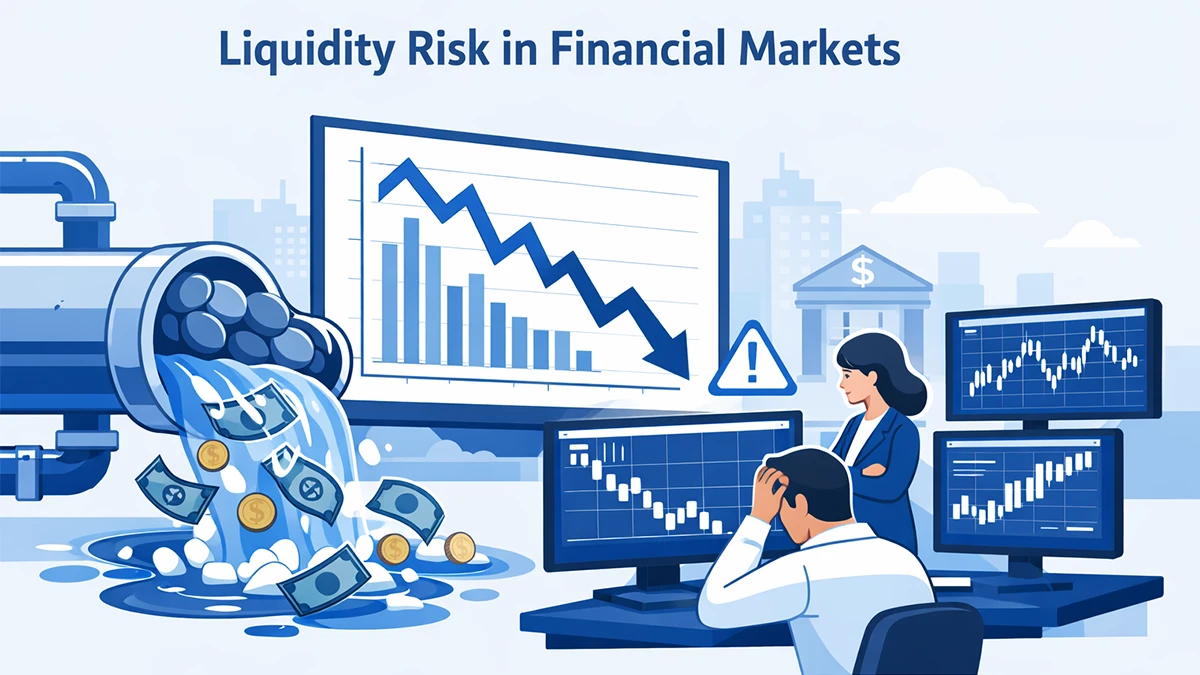
Liquidity risk in financial markets is the chance that you can’t buy or sell an asset quickly at a fair price.
It can also mean a bank or company can’t pay its short-term bills, even if it owns assets worth far more.
There are two main types. Market liquidity risk means you can’t sell your asset fast. Funding liquidity risk means you can’t raise cash fast. Both can cause serious damage to financial market stability.
What Is Liquidity in Financial Markets?
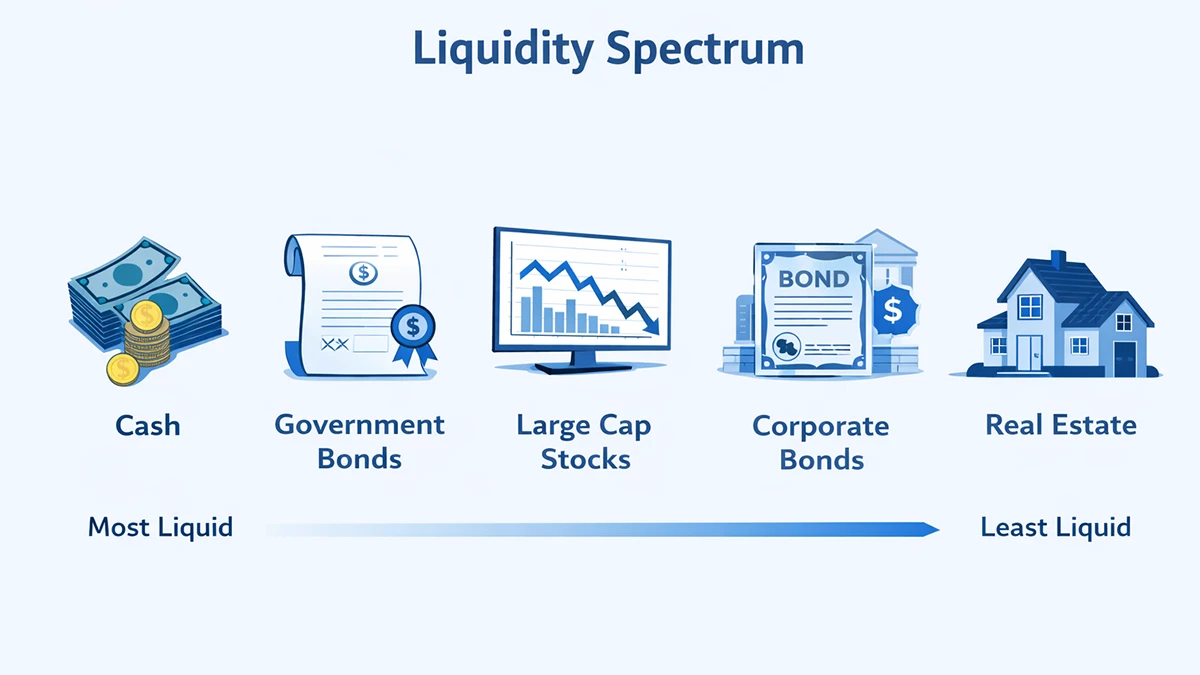
Liquidity is how easily an asset can be bought or sold without moving its price much.
Cash is the most liquid asset. Real estate is one of the least.
Market Liquidity Explained
Three things show how liquid a market is.
Market Liquidity Indicators
Bid Ask Spread
Small spread = liquid market
Trading Volume
High volume means easier buying and selling
Market Depth
More orders at different prices improves liquidity
Bid-ask spread: The gap between what buyers will pay and what sellers want. A narrow spread means a liquid market. A wide spread is a warning sign.
Trading volume: Higher volume means more buyers and sellers. That makes it easier to exit quickly.
Market depth: This shows how many orders exist at different price levels. Shallow depth means one large trade can move prices sharply.
Why Liquidity Matters in Capital Markets
Without liquidity, prices don’t reflect reality.
Liquidity risk in financial markets starts here, when this smooth process breaks down. When they’re not liquid, you can be stuck holding an asset worth less than you paid, with no one willing to buy it.
Types of Liquidity Risk in Financial Markets
1. Market Liquidity Risk
This is when you can’t sell an asset without taking a big price cut.
Small-cap stocks listed on India’s BSE SME platform often face this. You might own 10,000 shares but can’t sell them all without pushing the price down hard.
2. Funding Liquidity Risk
This is when a company or bank can’t raise cash fast enough to meet its bills.
Lehman Brothers had billions in assets in September 2008. But it couldn’t roll over its short-term debt. It filed for bankruptcy with $613 billion in liabilities.
3. Settlement Liquidity Risk
This one rarely gets explained. It happens when a trade can’t be completed on time, even if both sides want to settle.
Payment delays or system failures can cause this. It’s common in cross-border transactions with different settlement cycles. Bank for International Settlements: settlement risk and payment system oversight
4. Systemic Liquidity Risk
This is when the whole system runs dry at once.
One institution’s problem spreads to others. Banks stop lending to each other. Credit markets freeze. That’s the clearest case of systemic liquidity risk in financial markets spreading globally, as it did in the 2008 Global Financial Crisis.
Major Causes of Liquidity Risk in Financial Markets
Major Causes of Liquidity Risk
Market Volatility
Rapid price swings reduce market buyers.
Low Trading Volume
Thin markets increase price impact.
Asset Liability Mismatch
Short-term debt funding long-term assets.
Credit Downgrade
Borrowing becomes expensive quickly.
Bank Runs
Depositors withdraw funds simultaneously.
Several triggers can create a liquidity crunch. They often hit together.
Market volatility: When prices move fast, buyers disappear. Nobody wants to catch a falling knife.
Low trading volume: Thin markets mean even small trades can move prices badly.
Asset-liability mismatch: A firm borrows short-term to fund long-term assets. When short-term loans come due, it can’t refinance.
Credit rating downgrades: A lower rating makes borrowing harder and more expensive, cutting cash flow quickly.
Bank runs: When depositors panic and withdraw at once, even a healthy bank can face a cash crisis. Yes Bank in India saw this in March 2020. RBI’s action on Yes Bank restructuring 2020
Regulatory restrictions: Rules that limit how fast assets can be sold can trap investors in positions they want to exit.
How to Measure Liquidity Risk in Financial Markets
Liquidity Ratios
| Ratio | What It Measures | Formula | Healthy Level |
|---|---|---|---|
| Current Ratio | Short-term assets vs debt | Current Assets / Current Liabilities | Above 1.5 |
| Quick Ratio | Liquid assets only, no inventory | (Cash + Receivables) / Current Liabilities | Above 1.0 |
| Cash Ratio | Cash only vs short-term debt | Cash / Current Liabilities | Above 0.5 |
A cash ratio below 0.2 means very thin liquidity. A company at that level is one bad month away from trouble.
Market-Based Indicators
Watch these for early signs of liquidity risk in financial markets building up.
A widening bid-ask spread means buyers are pulling back. Falling market depth means large orders will move prices badly.
Actually, the metric that moves first is nearly always the bid-ask spread. It widens hours before trading volume visibly drops.
Stress Testing
Banks run simulations to ask: what if 30% of deposits leave in one week?
The results show how much buffer they really have against liquidity risk in financial markets turning severe.
Impact of Liquidity Risk on Financial Markets
Liquidity risk in financial markets hits everyone differently.
Banks borrow short and lend long by design. When funding dries up, they either borrow expensively or sell assets at a loss.
Corporations find working capital harder to get. Even profitable companies have gone under because of a short-term cash gap.
Investors face forced sales. Margin calls come in, and if you can’t meet them, your broker sells your positions at market price.
Capital markets see price discovery break down. Prices no longer reflect value. They reflect panic.
How Liquidity Risk Triggers Financial Crises
Liquidity problems spread like fire in dry grass.
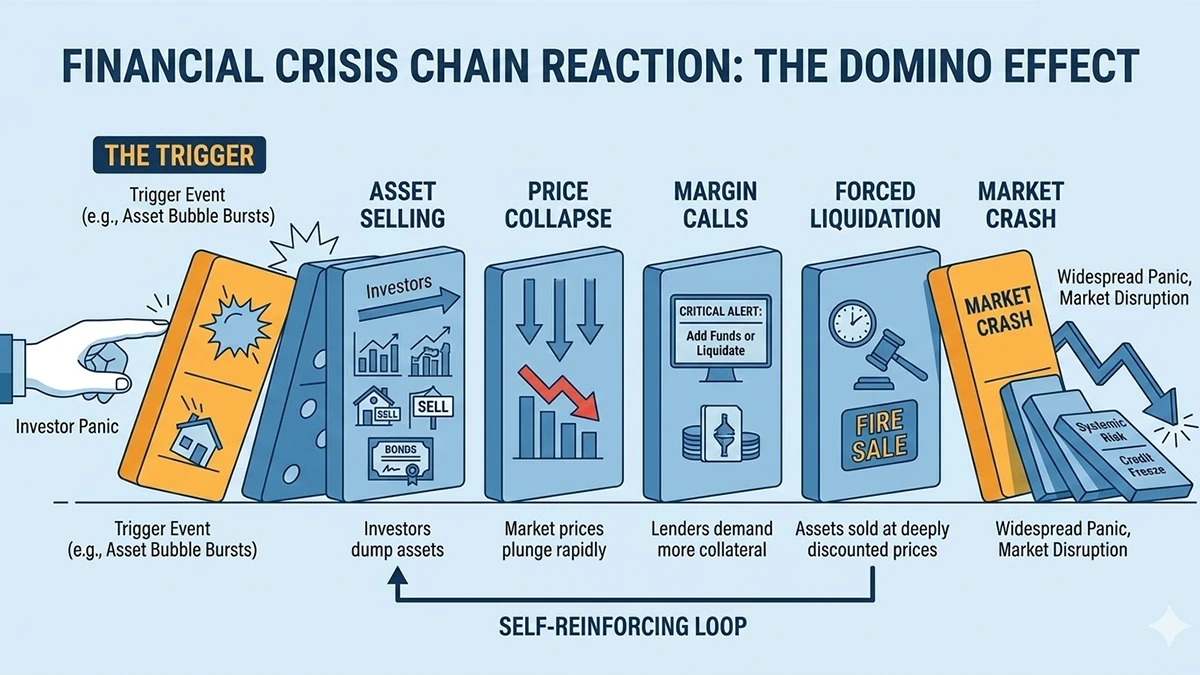
When one fund is forced to sell, prices drop. That triggers margin calls at other funds. They sell too. Prices drop more. The cycle feeds itself.
In 2008, mortgage-backed securities lost 30 to 60% of value. Not because all the homes were worthless. It was because nobody would buy them at any reasonable price.
And the 2020 COVID shock showed the same pattern can play out in under 10 days. That’s the nature of systemic financial risk and contagion in modern markets.
Liquidity Crisis Chain Reaction
How Banks Manage Liquidity Risk
After 2008, regulators built hard rules around liquidity risk in financial markets.
Bank Liquidity Protection Framework
Liquidity Coverage Ratio
Banks must hold enough liquid assets to survive 30 days of crisis.
Net Stable Funding Ratio
Long-term assets must be funded with stable sources.
Central Bank Support
Emergency liquidity provided during financial stress.
Liquidity Coverage Ratio (LCR)
Key Liquidity Ratios
Current Ratio
Current Assets / Current Liabilities
Quick Ratio
(Cash + Receivables) / Liabilities
Cash Ratio
Cash / Current Liabilities
Under Basel III, banks must hold enough high-quality liquid assets to survive 30 days of cash outflows in a crisis. The minimum LCR is 100%.
Net Stable Funding Ratio (NSFR)
The NSFR requires banks to fund long-term assets with long-term, stable money. It directly targets the asset-liability mismatch problem.
Both ratios came from Basel III, finalized by the Bank for International Settlements in 2017. BIS: Basel III liquidity standards overview
Central Bank Support
When markets freeze, central banks act. In March 2020, the US Federal Reserve launched emergency repo operations worth over $1.5 trillion in two days to keep markets moving.
How Investors Can Spot and Avoid Liquidity Risk
You don’t need to be a bank to protect yourself from liquidity risk in financial markets.
Investor Liquidity Risk Checklist
Check trading volume before you buy. If a stock trades fewer than 50,000 shares a day, exiting a large position without moving the price will be hard.
Watch the bid-ask spread. A spread wider than 1% of the stock price is a sign of thin liquidity.
Avoid concentrating in illiquid assets. Real estate, small-cap stocks, and certain bonds can all become very hard to sell in a downturn.
Keep a cash buffer. Cash means you don’t have to sell at the worst prices.
But don’t assume big funds are immune. Franklin Templeton India shut down six debt funds in April 2020 because of liquidity risk in financial markets. Investors couldn’t access their money for months.
FAQS on Liquidity Risk in Financial Markets
What is liquidity risk in financial markets?
It’s the risk that you can’t sell an asset or raise cash quickly at a fair price. It affects investors, banks, and companies. At its worst, it can freeze credit markets and trigger a financial crisis.
What causes liquidity risk in financial markets?
Low trading volume, market volatility, asset-liability mismatches, and sudden cash outflows like bank runs are the main causes. Credit downgrades can also cut off funding very fast.
What is an example of market liquidity risk?
Owning a small-cap stock with low daily volume. If you need to exit quickly, you may have to drop your price by 10 to 20% just to find buyers.
How do banks manage liquidity risk?
Banks use the Liquidity Coverage Ratio and Net Stable Funding Ratio under Basel III. They also hold liquid asset buffers and can access central bank emergency funding.
What is the difference between funding liquidity and market liquidity?
Market liquidity risk is about selling assets quickly. Funding liquidity risk is about raising cash to meet bills. A company can have plenty of assets but still face a funding crisis if it can’t convert them to cash in time.
Putting It All Together
Liquidity risk doesn’t announce itself. It shows up in widening spreads, falling volumes, and suddenly frozen markets. The investors and institutions that survive understand one thing: liquidity is a privilege that disappears exactly when you need it most. Build your buffers before the stress arrives, and you’ll never be forced to sell at the wrong price.
Disclaimer: This article is for educational purposes only and does not constitute financial advice. Always consult with a qualified financial professional before making investment decisions.